Rolling Stones of Broken Beliefs

( Originally posted to my “From Here to Discernity” blog at SantaFe.com, November 21, 2011)

I live within walking distance of DeVargas Center on the north side of town. Two or three times a week I’ll walk by the mall, or to the mall, depending on my needs or curiosities.

Yesterday my curiosities led me to notice the rocked slopes that separate the high ground of the Wells Fargo Bank at the corner of Paseo de Peralta and Guadalupe, from the lower parking lot in front of Sunflower Farmers Market and Mattress Firm.

I’ve often walked down the stones on the slope as a shortcut from Paseo de Peralta to the mall. The stones are set in a base of cement, presumably to hold the stones in place as well as to prevent erosion of the soil on the slope. (Although I’m not sure that suffocating the soil with cement was done for the benefit of the underlying soil as much as to keep it out of the asphalt parking lot below.)

In a couple of places, enough stones are missing that it’s easier to walk up and down the embankment. I was walking down one of these “paths” yesterday when I was struck with the realization that these missing stones mean something. At least, they meant something to me.

The layer of cement serves as a foundation for the stones. The foundation was intended to hold the stones in place while providing a decorative and functional “natural-looking” covering for the slope. But over time, some of the stones had broken free of the foundation and rolled away, or were carried away. The foundation remains, but some of the stones that were set into the foundation are no more.

What kind of homily would you take from this? What lessons, associations, or metaphors could be drawn from this picture of stones broken free from their foundation?

What I drew from it, even as I was blithely stepping where the stones had been, was that this was about the failure of the foundation. The cement foundation was supposed to hold the stones in place. Some of the stones were gone, so the foundation failed its purpose, even though the foundation itself was still intact. And while it still covered the terrain, it didn’t hold the stones that were set into it.

I think that’s a good metaphor for what we humans have learned to do with all manner of beliefs.

Like the cement foundation on the slope, we lay down a certain set of fixed beliefs about how things should be. We have religious beliefs, of course, but also political, cultural, romantic, artistic, academic … in virtually every domain of experience, we maintain a foundation of beliefs about the way things are, and the way things ought to be.

As we go through our lives, we accumulate experiences that we set into our base of beliefs, like the stones set into the cement. Our beliefs bind our actions and life experiences into a rock-solid understanding of what our life events mean. Our beliefs hold our doubts and insecurities and uncertainties in check; they prevent our “soul erosion,” just as the cement on the slope prevents soil erosion.

But the problem is, sometimes we have life experiences that become unbound from our belief systems. We have a Penn State child rape scandal. We have police pepper-spraying college students on campus. In the midst of economic crisis, we have unapologetic politicians bound to ideology more than attacking the crisis. We have some who value corporate interests over human interests, for whom “excess” represents a strategic objective rather than a constraint.

These are just a few of many distressing real-world examples in which our institutional beliefs ought to be shattered. Time after time, misplaced faith in someone or some institution results in tragedy, or scandal, or misfortune.

And yet, like the cement on the slope at the DeVargas Center, our beliefs remain intact, undeterred by any awareness that they have failed us.

We accommodate the unbounded experience as an outlier, an exception. We rest comfortable with the lazy rationalization that, while our beliefs didn’t bind this particular tragedy or mishap, look at all the other stones on the slope that are still fixed firmly in the foundation!

The important thing is the constancy of our beliefs. The important thing is the uncritical and undoubtable loyalty to the Party, the University, the Authority, the Status Quo, the Tradition.

It’s all about the cement and the stones that stay in place. It’s not about the stones for which the foundation fails, that unbind and roll away.

Until, that is, the next time our blind obedience to a broken belief yields the inevitable next manifestation of “the unthinkable.” Then it will be about those other stones.

Until the next news cycle. But it will never be about the failure of the foundation and broken beliefs.

Learning is for Noobs

(Originally posted to my “From Here to Discernity” blog at SantaFe.com, September 12, 2011)

I first heard the term “Internet” at a Halloween party in 1993. An attractive friend of a co-worker, cutely disguised as the Cat in the Hat, mentioned that she was writing her Masters thesis in Computer Science about “how to access the Internet.”

I didn’t have a clue what she was talking about. But in 1994 I signed up for this cool service called America Online that I could dialup on my 2400 baud modem for electronic mail, bulletin boards, and listservs. I wasn’t “on the Internet” (so far as I knew then) but I was on America Online with my monochrome green-on-black monitor. Sometimes I got e-mail from friends who were also on the America Online, CompuServe, or Prodigy services.

The next year I had my “ah-hah!” moment about the Internet. Some friends and I were brainstorming about ideas for our 1995 Halloween party. Somebody suggested a Charlie’s Angels theme.

Note: For historical clarification, this refers to that ‘70s TV series that originally featured Jacqueline Smith, Kate Jackson, and Farrah Fawcett as the “angels.”

Somebody asked how many different actresses played “angels” during the course of the series. Curious, I logged onto my IBM-compatible computer, opened my Netscape Navigator web browser, and went to the Yahoo! search site to see if I could find out something about “charlie’s angels.”

I was, frankly, amazed. Not only did I quickly find a list of all the actresses and their character names, but full bios — not of the actresses, but of their characters. And synopses of every episodes of a TV series that had been off the air for 14 years. And at least 50 links to sites that were all focused on one topic — Charlie’s Angels.

That’s when I figured this Internet thing wasn’t just another CB-radioish fad.

All that is just a preface to establish my cred as an Internet “early adopter.” Because the real purpose of this post is to confess that I’ve crossed whatever threshold separates “early adopter” from “old fart.”

I know I’m on the sunset side of that divide because of my “Summer of WordPress 2011” experiences.

I started a WordPress blog two years ago, initially to document what I could about the one and only local hospital and its relationship to and with CHRISTUS Health. Then I got interested in tracking the curious electrically-sensitive trail of a Santa Fe resident who filed a lawsuit against a neighbor for using her iPhone.

Last January I began a novel about Annie, a fictional character who came of age during the Manhattan Project in Santa Fe and Los Alamos. As a story-telling conceit, the narrator recounts her memoirs in the form of an actual WordPress blog.

Since I was spending so much time with WordPress, I wondered what else I might be able to do with it.

So this past June I impulse-purchased a “Premium Theme” that promised me the capability to easily create my own themes with “drag & drop” functionality. Only after I purchased the theme, installed it, and tried to do something with it did I realize I had purchased a software package that had no documentation.

Now, the sellers of the software would deny that accusation. In their defense, they would point to the “Documentation” section of their website, a dozen or so video “tutorials,” and their online Forum for Q&A’s with “pros” to answer any specific questions we noobs might have.

“Of course we’ve got documentation!”

My cross-examination of that defense would then go like this: Documentation for users is not a description of features found in a marketing brochure. A tutorial is a set of instructions for “how to,” not a demonstration of capabilities. It’s hard to formulate a specific answerable question when your foremost concern hinges on “where do I even start?”

It was during this give-and-take, back-and-forth, wailing-and-gnashing that I realized I had crossed the unseen and unexpected divide into old fartdom.

My crossing was manifest by my quaint, retro, old-school expectation (desire?) to learn what I was supposed to do before I tried to do it. How positively Commodore 64-ish is that? LOL.

In the age of iOS, Android, SMS, and Twitter, the operative technological premise, to paraphrase the pre-cyber Yoda, “Learn not. Use! Or use not. There is no learn.”

Translation: With today’s technology, you don’t learn how to use it … you just use it. Learning requires instructions and directions and practice. Using requires eyes and fingers and intuitive doing. Learning seeks to avoid mistakes. Using requires mistakes, but then that’s what Undo is for.

I should’ve seen this coming if I had been paying attention to the IBM and Apple commercials back in the ‘80s. This IBM PC commercial clearly reveals the old-fartish mindset about documentation, which the up-and-coming Apple Macintosh ad then pokes fun at.

Back in the ‘60s, the generational dividing line was targeted at a specific age: “Don’t trust anybody over 30.”

Now it’s not related to age as much as attitude: “Don’t trust anybody who asks for instructions.”

As Yoda counseled, we have to “unlearn what we have learned.” And in the end, that’s probably a good thing. Just do, but don’t tell anybody you’re learning by doing.

Adherence to Appearance

(Originally posted to my “From Here to Discernity” blog at SantaFe.com, September 12, 2011)

Two decades ago, I took a “self-improvement” seminar in Dallas. The seminar leader, an out-of-towner, commented in the beginning that, “I’ve heard Dallas is all about looking good.”

I recalled that observation last week while I was reading about the year-long drought in central Texas. A New York Times article by Manny Fernandez chronicled the dire situation in Llano, Texas, ninety miles northwest of Austin.

An aspect of the water shortage that Fernandez focused on was its effect on lawns and landscaping. The city council enacted restrictions that prohibit watering lawns except for one day a week. As a result, most lawns are distressed, at best, and many have withered away to weeds.

Those homeowners fortunate enough to have private water wells are not subject to the restrictions. In order to preempt the ire of neighbors, those well-watered green lawn owners have been compelled to post signs in their yard indicating WELL WATER was used.

The State Farm Insurance agent in Llano didn’t have a well to water his business landscape, but it was green anyway. How? The article explained that the insurance agent asked his landscaper to apply a green dye to his parched yellow lawn. At least it looked like green grass.

One of the things I appreciate most about Santa Fe and northern New Mexico is that the people who have settled here throughout history have adapted to its geography and climate. For the most part, they haven’t attempted to create an artificial environment (like some cities in Arizona I could mention).

To a Santa Fean, the thought of painting a lawn makes about as much sense as painting dirt. Which, of course, is the primary palette of most landscapes here. Nothing about northern New Mexico is amenable to lawn grass, so most people have yielded to practicality and turned to more native landscaping solutions. Or none at all — nature au naturel, so to speak.

However, Santa Fe does have something of an obsession about the appearance of things built on the landscape.

On the same day I read about drought in Llano, Texas, I read that vandals tagged the backside of the Garfield Building at the corner of Sandoval and Garfield. The owner of the building told the Santa Fe New Mexican that dealing with spray paint on this building was difficult.

He explained: “The stucco is not like the stucco sprayed on many fake adobe buildings, because it includes straw to mimic traditional plasters used for centuries on Santa Fe houses.”

The implication in the owner’s explanation is that when it comes to falsifying architectural appearances in Santa Fe, there’s a hierarchy.

On the low end, there’s “stucco sprayed on fake adobe buildings.” Moving on up the ladder of presumed acceptability is the addition of “straw to mimic traditional plasters.”

Both processes mean to achieve the same end of providing an artificial façade to give the appearance of authenticity.

That’s Santa Fe’s architectural Achilles heel — an obsessive adherence to historical appearances that are long past practicality.

Having called Santa Fe home for 32 months now, I realize this topic is touchy, or even untouchable, for most. So I’ll criticize another city to illustrate my objection to this type of aesthetically-stunted mindset.

Last fall I spent a weekend in Alexandria, Virginia. Strolling along the streets of Old Town on the west bank of the Potomac River, I gazed in appreciation at the 18th-century houses and buildings. I tried to imagine what it would’ve been like here during the Revolutionary period, the Civil War, the early 20th century.

At one point I walked past a block-long building of apartments and found myself confused. Was this an original period building, or was it new? A realtor’s sign at the corner answered my question. It was a new building of condominiums, still offering attractive financing, according to the sign.

I felt put out. My appreciation of the authentic buildings was challenged because of all the visual noise created by the artificial “made-to-look-like” new buildings. The new look-like designs didn’t pay homage to the originals. No, they attempted to expropriate the authenticity of the originals to give their knock-off façades some street-view historical credibility.

Doesn’t our 54-year old Santa Fe Historical Zoning Ordinance promote this same mandate to “honor” the past by visually obscuring it with look-like architectural fakery and mimicry?

If someone sells a watch or a handbag on Canal Street in lower Manhattan that artificially appears to be authentic, he’s illegally selling knockoff merchandise.

If someone designs a building in Santa Fe that artificially appears to be authentic, he’s legally complying with a city ordinance.

Painting grass to look green. Adding straw to stucco to “mimic traditional plaster.”

The “City Different?”

Not really, when it comes to an adherence to appearance.

What a Marriage a Difference Makes

(Posted to my “From Here to Discernity” blog at SantaFe.com, September 1, 2011)

I met Marisa when she enrolled in my general semantics class at TCU (Texas Christian University in Fort Worth, TX) in January 2007. After she graduated that spring, she worked for me at a nonprofit organization I managed. She became friends with my daughter Stacy when they traveled to New York City later that year to represent the organization at a convention.

Marisa moved back to her native Albuquerque in 2008. I moved to Santa Fe in 2009.

My daughter has visited me six times in my two years here, and three of those times we’ve gotten together with Marisa and Aaron, her boyfriend. The reason for Stacy’s most recent visit in mid-August was to attend Marisa’s and Aaron’s wedding.

I know Marisa better than I know Aaron, so my comments here apply more to her. But I believe I can generalize about “them” without too badly mischaracterizing Aaron.

Marisa and Aaron are different. What I mean by that is that they are each very much their own individual selves. More than almost anyone I’ve ever known, Marisa and Aaron are different from anybody else. In other words, there’s no one person in my 57 years of experience that I could say Marisa is “like” or comparable to. Marisa is like Marisa, nobody else. (Notwithstanding her celebrity-lookalike resemblance to Katie Holmes.) And the same with Aaron. (Without the notwithstanding qualifier.)

To my mind, they exemplify Emerson’s notion of individualism as expressed in “Self-Reliance”:

No law can be sacred to me but that of my nature. Good and bad are but names very readily transferable to that or this; the only right is what is after my constitution, the only wrong what is against it.

Thus it was no surprise to Stacy or me that — from their wedding announcement to the invitations to the ceremony to the reception to the honeymoon — Marisa and Aaron rightly pursued their own constitutions. It was as though their wedding planning premise was, “Bridal magazines? We don’t need no stinkin’ bridal magazines!”

Nor did they need any of the traditional matrimonial staples that have become de rigueur to the point of cliché. Solemnity was given the day off, which was just as well since they had an outdoor ceremony at a vineyard north of Albuquerque. First wedding I’ve been to with a wine bar available on your way in.

Cute kid ring bearers? Nope, but their two dogs were front and center. Formal wear? No coats, a few ties, a vest to distinguish the groom. Father of the bride “giving away” his daughter? No, he was seated with the rest of the family. Center aisle processional? The bride and groom strolled around the grounds visiting family and friends. With the clouds gathering ominously and thunder in the distance, the groom casually announced, “Hey, I think we’re ready to start.”

Aaron’s sister Katy officiated. The welcome, readings, and vows resulted from collaboration among the three of them. Knowing that Marisa is keenly aware of the significance of language because of her past work in general semantics and her current work with the Center for Nonviolent Communication, I expected the ceremony to be different in a meaningful way.

I was not disappointed.

Katy’s welcome established that this day was not a grandiose beginning fraught with before-and-after significance, but simply a public acknowledgment of a “bond that already existed.” She talked metaphorically about their relationship as though it were a sustainable farm, with references to sowing, reaping, yields, harvests, depletion, and nourishment.

In particular I was struck by a line in their vows in which they each committed to take care of themselves (diet, health, etc.) in order to contribute to a longer relationship with each other.

I liked that, especially in its contrast to the traditional line about “in sickness and in health.” To me, that standard line passively submits to an inevitability over which individuals have no control. As if fate, or chance, or luck, or fortune determines whether or not “Health Happens.”

Instead, Marisa and Aaron operationalized their commitment to each other by, in effect, declaring that they were going to take care of themselves for themselves, for each other, and for the longest possible sustainment of their relationship.

I’m happy for Marisa and Aaron. I’m not frivolously optimistic about the future, but it’s reassuring to see a young couple so courageously stick it to tradition. I don’t mean just during their wedding, but in their overall attitudes about living in a world that is so caught up in societal should’s.

I recall the sentiment attributed to Einstein:

It gives me great pleasure indeed to see the stubbornness of an incorrigible nonconformist warmly acclaimed.

So, warm acclaims all around for Marisa, Aaron, and the marriage their differences will make.

Indian Market: Why this and not that?

Originally posted at my “From Here to Discernity” blog at SantaFe.com (8.22.11)

Yesterday I sauntered down to town to stroll through my third Indian Market. I’m a looker, not a buyer or collector, so my eye is less critical and less easily captured. If pressed to honesty, I’d have to admit I’m there for the gestalt of the experience, which includes a lot of crowd wondering — why are they looking at that, where will they put it, what does the rest of their house look like if that’s going to fit in?

While playing my little gestalt game yesterday, I had an insight about beauty. Actually, it wasn’t an insight as much as it was a recall of an aphorism I learned as a child. From an ash tray.

When I was in grade school, we lived in Pampa, Texas. Even though neither of my parents smoked, we had ash trays scattered around the living room. Probably as much for decoration as functionality.

One of these was a white, oversized, hard-glazed ceramic thing in an irregular shape. Inside was a cartoonish painting of a Cruella-Deville-ish looking lady with a big cigarette holder sticking out of (or into?) her mouth. A painted caption beside the lady read, “Beauty is in the eye of the beholder.”

That oft-repeated cliché has stuck with me as an adult. Not because I’ve heard it repeated so often, but because of its simple obviousness and unintended (I’m sure) neurologically-accurate statement of a biological fact.

Every one of us sees with a different pair (if we’re lucky) of eyes, and what we see is processed by a brain (if we’re lucky) that’s different from anyone else’s. Therefore, neurologically-speaking, no one of us sees exactly what someone else sees.

During the Renaissance, Leonardo da Vinci spoke of this individual uniqueness:

“All our knowledge has its origins in our perceptions.”

Jeff Hawkins, author of On Intelligence, explained these perceptions in terms of pattern-matching in his 2009 J. Robert Oppenheimer Memorial Lecture:

“your perception of the world is … really a fabrication of your model of the world. You don’t really see light or sound. You perceive it because your model says this is how the world is, and those patterns invoke the model.”

If you want to get technical about it, beauty isn’t therefore “in the eye” as much as it’s “constructed by the brain” that’s connected to the eye. And according to Hawkins, and other neurologically-informed researchers, what we call beauty is culturally-dependent based on what patterns we’ve learned to match and label as beauty.

This seems to make a persuasive case against any notion of “objective” or “inherent” beauty.

I thought about this yesterday while I was walking from booth to booth at the market. The crowd was dispersed. Some booths had no customers at the time I walked by, while others held the attention of an interested couple or several individuals.

But no booth was overly crowded. No booth contained such beauty that it was disproportionately visited. That must mean, to my mind, that different people have different tastes about what pleases their own individually-learned aesthetic sensibility.

“Beauty is in the eye of the beholder” holds up well to this type of anecdotal observation.

I had another thought as I navigated my way through the Indian Market crowds yesterday. That ash tray I mentioned had a functional, as well as a decorative (taste aside) purpose. Most of the objects for sale by the Indian artisans were, at least at one time, inspired by a need for function rather than decoration.

Pottery is probably the most obvious example, but with adequate historical perspective one can make the case that jewelry, clothing, leather works, wood carving, and even painting all had roots in cultural necessity, rather than nicety.

This is especially true in the case of the native pueblo peoples in Northern New Mexico. In the fine KNME-produced documentary “Painting Taos,” Taos pueblo descendant Paula Rivera notes that:

The word ‘art’ is not in our native vocabulary. We don’t have a word for that because everything that we do is a part of that thought. It’s in our daily life, everything that we do, it’s an art form. The pottery that we make, the drums we make, the hides we tan, the horses we take care of, the fields we water, I mean, everything, that’s an art form.

I don’t want to make a judgment, other than to highlight the difference that Ms. Rivera is articulating. Inevitably, there must be implications when the motivation to produce “functional art” evolves from cultural necessity to economic necessity.

I think those differences and implications are worth pondering, by both the creators and the beholders of the beauty on display during Indian Market.

The Cross that Came Before

This was originally posted on my “From Here to Discernity” blog at SantaFe.com (submitted July 23, 2011).

I’m not proud to admit that I live on the computer. Every day, I create, modify, copy, move, and otherwise manipulate dozens, if not hundreds, of many different types of computer files.

It’s a storage, backup, and configuration management nightmare, given that my modest little network consists of 4 computers (3 PCs, 1 Mac), 5 external hard drives, and almost 7 TB (that’s terabytes) of storage. With just a few exceptions, I do my best to keep only the most recent version of any given file.

So I’ll typically “write over” an older version of a file with whatever the newest version is. I figure I don’t need to keep up with the progression of changes throughout a file’s history. I’m just interested in whatever the most current version is. This attitude works, from my point of view, when it comes to managing my own personal electronic files.

That attitude, however, doesn’t work in the real world of societies and cultures and histories. There’s a difference between abstract data files and the concrete real world. You can’t just “write over” the past with whatever the current condition, circumstance, or reality is.

Well, that’s not exactly right – we “write over” buildings and landscapes all the time. This notion has been integral to Santa Fe throughout its historical development, from the uncovering of ancient settlements deep below downtown to the erection, then demolition, of the Paolo Soleri amphitheater.

But somewhere, somehow, someone needs to document through words, images, and sounds what has come before now. We need to capture, retrieve, and remember the historical progression of different “versions” of buildings, events, scandals, celebrations, and people that have contributed to now.

Otherwise, we’ll inevitably develop a mistaken mindset that the way things are now is the way things have always been. Which must mean that’s the way things are supposed to be, which in turn must mean that this is the way things should be in the future.

One visible example of what I fear may be an in-progress historical “writing over” is the Cross of the Martyrs. Not the one you’re probably thinking of at the top of Hillside Park near the old Fort Marcy ruins. I’m talking about the original, 1920 version made of concrete, not steel.

In my short time in Santa Fe, I’ve been amazed at how few local residents know about the original Cross of the Martyrs situated just north of town, west of the Old Taos Highway off of Paseo de la Cuma. The concrete cross was dedicated in September 1920 during Fiesta. The original plaque is inscribed:

ERECTED BY MEMBERS OF
THE KNIGHTS OF COLUMBUS AND
THE HISTORICAL SOCIETY OF NEW MEXICO
IN MEMORY OF THE FRANCISCAN FRIARS
WHO WERE KILLED BY THE PUEBLO INDIANS
IN THE REVOLUTION IN THE
PROVINCE OF NEW MEXICO
AUGUST 9TH AND 10TH A.D. 1680

A free-standing plaque beside the cross explains that “The Historic Santa Fe Foundation Finds This Site Worthy of Preservation 1994.”

As if it takes a proclamation from a historical foundation to determine that a 74-year old, 25-foot tall concrete cross that’s 8 feet deep and weighs 76 tons, that watched prominently over Santa Fe from a perch that was then visible from anywhere in town, was “worthy of preservation.” Duh.

But “worthy of preservation” doesn’t mean “will be preserved.” In addition to being written over in memory, the original Cross of the Martyrs has almost been written over by development. The cross is accessible only from a winding dirt street by a narrow set of steps secured by railroad ties. Houses, driveways, privacy fences, and the dirt street encircle it. A visitor can only imagine what the view once was, thanks to a photo on the plaque.

I suspect it’s only a matter of time before one of the nearby property owners tires of having the deteriorating behemoth spoil what little view remains. A well-connected friend, a change to a preservation code, a donation for this or that … I can foresee any number of tactics that in a few years will probably render this 91-year old monument as “written off.” Literally.

Not that I’m all that sentimental about memorializing martyrs. I’m well aware of how controversial the history of this area is regarding the Spanish conquest and the Pueblo Revolt. Or I should say, I’m aware that the commemoration of those historical events remains controversial, as evidenced by the vandalism of the 1977 version of the Cross of the Martyrs prior to the opening of the 2010 Indian Market.

But that’s for a different post. I just wanted to write down a few thoughts about something before it’s written off. And carted away, for the sake of a better view.

8 Passages for Uncertain Career Journeys

My friend and former career adviser Helen Harkness was asked to edit a special edition of a journal for career development professionals in 2010. She invited me to submit an article/essay, which was accepted. The theme of the special edition was Mid Life Career Crisis: How chaos theory and positive psychology can help.

The edition was published and distributed in February 2011, although the cover unfortunately and mistakenly notes “Spring 2010.” I also was displeased with the production formatting of my article, “Passages for Uncertain Career Journeys,” in that the production editor suppressed most of my paragraph breaks. Therefore I’ve converted the text to HTML with my intended formatting, shown below.


I sat back in my chair, content with yet another recitation of my life’s achievements. Looking across the desk and out the window, past the placement specialist who specialized in placing ex-military junior officers at leading corporations, I hoped this would be the last of these interviews. I gazed across the nondescript suburban office complex toward downtown Houston. Was this the landscape of my future?

“So let me get this straight.” Glancing up from his notes, the specialist brought me back to the present.

“You didn’t really know what you wanted to do coming out of high school. You went to the Air Force Academy because it was the best college offer you got, not because you really wanted to go there. You didn’t know what you wanted to study, so you majored in Humanities because you made better grades in those courses. Your eyes were too bad for pilot training, so after graduation you went to navigator training because you were told that was your best opportunity. You gave up a graduate school slot because you decided to get out of the Air Force, and now you’re looking for a civilian job. But you can’t really say what you want to do.”

“Other than,” he glared at me as though I were a defendant under cross-examination, “you’re just looking for ‘the best opportunity available.’ Did I get that right, Mr. Stockdale?”

I didn’t appreciate it at the time, but I had entered the turbulent waters of my first uncharted career passage. I had left a secure, predictable, but unfulfilling work life where my responsibilities were simply to follow orders. I didn’t know where I wanted to go or what I wanted to do. I just wanted to find an employer who wanted me. Then I’d prove myself and adjust, just as I had adapted to life at the Air Force Academy and in the Air Force. And that’s what I did, for awhile.

Two months after that interview in 1982, I got a job in program management at a defense electronics company in the Dallas area. After seventeen years (which included a divorce, midlife crisis, and multiple attempts to find another job), the company moved our business unit out of state. Rather than relocate, I accepted a severance package. Six months later, I found a similar job with another defense electronics company. I lasted a year before I remembered how much I didn’t enjoy that kind of work. Then I attempted to begin an Internet venture; three months later I admitted failure. For the next two years I worked part-time for a nonprofit organization while I tried and failed to develop a consulting business. Then I became the full-time chief executive of the nonprofit and felt, finally, that I had found my place, my career home. Four years later I resigned when it became apparent that the trustees did not share my vision for the organization. I taught one course as an adjunct professor at a private university. For a year I produced virtually no income. I moved to Santa Fe to fall back, re-group, and start over. Two years later, I’m still re-grouping while enrolled in an Educational Psychology graduate program. I’m doing what I want to do.

My ‘expertise’ is obviously not in realizing a successful career. I have, however, survived a series of career passages that, of course, are unique to me. But it’s possible that some of my experiences and learned lessons can serve to instruct, motivate and even inspire some of your clients. Therefore I offer these eight passages that have helped me navigate my own career journeys — from my own self-exploration and discoveries, to the potentially paralyzing fears and anxieties of the unknown, to the zigs and zags of good and bad decisions, and through the unexpected and unpredictable circumstances that have brought me to my current, self-selected, present position.

Passage 1

I lived with the terrible knowledge that one day I would be an old man, still waiting for my real life to start. — Pat Conroy (1)

Before your clients come to you, they’ve probably already experienced some kind of triggering event or catalyzing moment, possibly resulting from factors that have been accumulating over time. My moment came when I read this passage from Pat Conroy’s novel, The Prince of Tides. Conroy, through his fictional character, expressed an inner feeling that had resided in me for several years, but I didn’t have the courage, awareness or vocabulary to articulate it myself. For almost twenty years, this statement has served as a touchstone for me to measure my progress against, as well as a consistent source of motivation and encouragement for me to live my real life.

Of course, this specific quote may not mean much to your clients. They may have different quotes, anecdotes or experiences that serve a similar purpose for them. If so, encourage them to keep those memories handy. And if any of your clients have not verbalized that trigger or event, ask them to articulate it in whatever way they’ll find most meaningful. Because at some point during their own explorations into uncertainty, they’ll need to remember why they chose to embark on this journey, and why they don’t want to turn back.

Passage 2

The self explorer, whether he wants to or not, becomes an explorer of everything else. — Elias Canetti (2)

Like me, your clients may have difficulty in answering the question, “What do you want to do?” Of course, if they can admit that to you (and themselves), then they’ve already taken the first step in acknowledging that they need to undertake a process of internal examination, exploration, and discovery.

Psychological assessments and inventories can provide indispensable insights to individuals seeking to better understand themselves. I considered myself to be more self-aware and introspective than most. But I realized how much more of my “self” I needed to explore when I became familiar with instruments such as the Strong-Campbell Interest Inventory, the California Psychological Inventory, the Myers-Briggs Type Indicator, the 16PF Development Profile, and the Holland codes indicated by the Self-Directed Search. Integrating the results of these tools with my own life experiences, I gained insight and understanding that I don’t believe would’ve been possible otherwise.

For example, my Myers-Briggs results highlighted two items that I found immediately relevant and helpful. My type (E/INTJ) indicated that I did not exhibit a clear preference on the Extraversion-Introversion scale. This ambiguity can result in internal tensions in terms of whether or not I want to work alone or with other people; how willing I am to assert myself in a leadership role; and how willing I am to socialize, network, develop contacts, etc. I also understood how my type results define the boundaries of my temperament preferences, or “comfort zone.” I realized that my strong preferences toward the iNtuitive, Thinking, and Judging scales revealed potential deficiencies on the other ends of the scales. In other words, to expand my “comfort zone” with a strong iNtuitive preference, I could benefit by paying more attention to the cold hard Sensing facts of a situation; with a strong Judging preference, I needed to exercise more Perceiving spontaneity.

I think it’s important for clients to understand three things regarding their strengths as indicated by assessment instruments. First, clients need to build on their strengths; these are what most differentiate them from others and most likely feed into their interests, motivations, etc. Second, clients should not take their own strengths and natural abilities for granted; just because something comes easy to them, they should not assume that “it’s no big deal, everybody does that — don’t they?” Third, the cautionary adage about “too much of a good thing” holds true in terms of strengths; they can lead to problems, especially with respect to very strong Myers-Briggs preferences.

The results from these types of instruments may strengthen your clients’ sense of self-awareness, motivations, and expectations. These instruments can also, within limits, help clients gain understanding and appreciation for others in terms of similarities shared, or differences evidenced. So as clients utilize these instruments to explore themselves, they may also find them useful in exploring their relationships with others.

Passage 3

By midlife, most of us are accomplished fugitives from ourselves. — John Gardner (3)

One of the possible outcomes of self-exploration resulting from career uncertainties is the realization that a sizeable gap may exist between one’s long-held self-perceptions, and what one discovers from these explorations. “Where did the old me go? How did I end up here? Who am I really?” As part of the career development process, your clients will each have to reconcile this gap; what do I want to be true, and what will I have to do to make it so?

This gap between self-perception and reality is lyrically reflected by John, bar friend to Billy Joel’s “Piano Man”: Well I’m sure that I could be a movie star, if I could get out of this place. John cannot make his self-perception (movie star) become true because he can’t, or won’t, initiate the prerequisite (to get out of this place). Like Marlon Brando’s Terry in On the Waterfront (“I coulda been a contender”), Joel’s John has made himself a fugitive from his hopes, dreams, and possibly needs.

Sometimes we simply choose to say “no” to opportunities to escape this place. I said “no” twice.

From the day I graduated from the Air Force Academy and entered active duty, I wanted to return to the Academy and teach. I applied for a program in which the Air Force would send me to graduate school in preparation for a faculty position. I was accepted into the program, but I had to wait three years until my graduate school slot opened. Rather than wait, I decided to resign my commission when my duty commitment was over, which led me to that placement specialist’s office in Houston.

While working for a defense contractor in 1987, I was offered my dream job — a position I had lobbied top management to create in then-West Germany. But I turned it down because my wife wouldn’t consider moving. That, on top of other previous issues, resulted in a steady deterioration of my marriage, uncertainty and dissatisfaction with my employer, and a full-blown, no holds barred mid-life crisis. After three years of therapy, I had to accept that the marriage could not be maintained and I initiated a divorce.

Your clients would do well to realize that their occupational conflicts are inseparably interrelated with other realms of their lives such as marriage, family, friends, and social involvements. It’s difficult to compartmentalize career concerns without affecting or being influenced by other aspects of one’s life. If clients aren’t consciously aware of their own attitudes, behaviors, and relationships — across all aspects of their lives — the gap between self-perception and reality may grow; they may find they are fugitives from themselves in more than one respect.

Passage 4

The reasonable man adapts himself to the world; the unreasonable one persists in trying to adapt the world to himself. Therefore all progress depends on the unreasonable man. — George Bernard Shaw (4)

Whose sets of expectations are your clients trying to fulfill — theirs, or someone else’s? It’s become a theatrical cliché, and predictable plot conflict, to portray a doting parent trying to re-live past glories or live unrealized dreams through a child. Or the parents who expect to feed their own egos through the accomplishments of “my daughter, the doctor.” For a variety of reasons and circumstances, some children grow up with a desire to please their parents, or accept without question that they should follow in a parent’s footsteps.

A few years ago, I participated in a Career Day activity at a high school near Dallas. My assignment was to conduct mock hiring interviews to give the soon-to-graduate seniors an opportunity to practice their interviewing skills. I remember one young man whose résumé was filled with references to band, drama club, and several service organizations. I was surprised when he informed me of his college plans to major in accounting. Nothing on his résumé mentioned accounting, math, or business — all of his interests and accomplishments related to creative, social, or service activities. I asked him about his interest in accounting and he replied, “Well, my dad’s an accountant so I thought it would be good for me, too.” I asked him about his other interests — music, drama, his volunteering experiences. He explained, matter-of-factly, that he did enjoy all those things, but he didn’t see how he could make a living at them. On the other hand, he expected he could make a living as an accountant.

That’s a responsible, practical attitude for a high school senior. That’s conventional wisdom. That’s playing to the script, dancing to the beat, and coloring within the lines. I wonder, however, how many of these prudent 18-year olds will become career development clients over the next 20-30 years because they willingly, if unwittingly, appropriated someone else’s aspirations as their own.

Passage 5

There is no coming to consciousness without pain. — Carl Jung (5)

The term “growing pains” is not just a metaphor. Real growth can result in real pains and aches. The aphorism that nothing grows in nature without shedding is worth remembering in this context. The changes that one pursues in order to reconcile the differences between self-perceptions and actual life; the changes that result from self-explorations and recognition of personality, temperament, and attitudinal preferences; the changes that will propel one to correct back to “real life” — these changes will not be realized without some degree of anxiety, stress, discomfort, and even pain. Author Barbara Winter asks, “What would you do if you weren’t afraid?” (6) Every client should confront that question, as well as the implications of their own personal answers.

Rather than expose themselves to these emotional challenges, some clients may deny the need for significant change. They may rationalize that they just need to do a better job of adjusting or adapting to their circumstances. They may try to wish the change away or passively bequeath responsibility to Fate or Destiny: Things aren’t really that bad. I can make it until things get better. They may well become worried and fearful when contemplating what a major change might mean. As Helen Harkness has written, for them change isn’t possible until the pain of their actual present becomes greater than the fear of their imagined future. (7)

Jung also acknowledged the role that emotion, more so than reason, plays in initiating action: “There can be no transforming of darkness into light and of apathy into movement without emotion.” (8) Your clients were probably motivated to begin their journey of self discovery by their own versions of my waiting for my real life to start moment. As they actually venture out into the uncharted and uncertain waters of taking real action, they need to remember that triggering moment and the emotions that accompanied it. At this critical decision point in their career passage, when they either launch into the unknown or return to the intolerable comfort of living as fugitives from themselves, they will likely need the memory of that initial emotional charge to fuel their advance and deny their retreat.

Passage 6

If you are distressed by anything external, the pain is not due to the thing itself, but to your own estimate of it; and this you have the power to revoke at any moment. — Marcus Aurelius (8)

Emotional courage from a catalytic trigger may get your clients to embark on their journey into the unknown and uncertain, but of course that won’t be the last challenge they’ll have to confront. They can expect disappointment, failure, doubt, anxiety, and perhaps every emotion in their vocabulary. How they navigate around and through the myriad obstacles that can host these potential emotional crises is crucial to their willingness, motivation, and confidence to continue the journey. Events such as an ambivalent interview, a rejection letter from an editor, or a disappointing networking contact can become simple setbacks easily forgotten, or journey-ending crises, depending on how the client responds to them.

The growing field of Positive Psychology has much to say in this regard. As explained in the PBS series “This Emotional Life,” psychologists differentiate between rumination in which individuals tend to obsess or fixate over an event or a situation, vs. re-appraisal, whereby the event or situation can be evaluated from multiple perspectives or contexts. In other words, our emotions do not have to be held captive to emotional triggers, crises, and disappointments; we can control or re-appraise the degree to which those outside events affect our inside responses. Psychologist James Gross at Stanford University offers this finding in simple, unambiguous terms: “There is an important role for thinking in emotions. If you can change the way you think, you can change the way you feel.” Narrator Daniel Gilbert, talking about a class in forgiveness offered by Stanford professor Fred Luskin, explains that Luskin “provides exercises to help the students see that they can’t control what happened to them, but they can control how they think about it.” (9)

Channeling the spirit of Marcus Aurelius, the appropriately nautical aphorism reminds us that, “We cannot command the wind, but we can adjust our sails.”

Passage 7

The voyage of the best ship is a zigzag line of a hundred tacks. See the line from a sufficient distance, and it straightens itself to the average tendency. Your genuine action will explain itself, and will explain your other genuine actions. Your conformity explains nothing. — Ralph Waldo Emerson (10)

One of the standard mantras of career counselors and advisors is for clients to set goals and work religiously toward those goals to ensure a successful career. I’ve known people who were able to follow this formula to very successful and fulfilling careers. High school friends knew they wanted to become farmers, veterinarians, doctors, teachers, coaches, business owners, and that’s what they did. Classmates from the Air Force Academy became pilots, test pilots, airline pilots, space shuttle commanders, and even four-star generals. They set a course early and took off, into their own individual wild blue yonders.

This approach becomes problematic, however, for people like me, and perhaps some of  your clients, who have trouble answering that pesky “what do you want to do” question. That’s not to say that the principle of goal-setting can’t be applied by someone who is uncertain or conflicted — it just requires that the goal be defined a little more broadly and a little more flexibly. This quote from Emerson’s essay “Self-Reliance” serves as a reminder that point-to-point, direct line courses are great if possible, but during the course of any career there are going to be times when the job-related winds, currents, and other factors beyond the individual’s control preclude a point-to-point course. It takes effort, and confidence, to steer in a direction that you know is off the point-to-point course and will eventually require a compensating correction. But as Emerson points out, careful, deliberate, and accurate tacking will get you to your destination; what’s important isn’t the track of the tacks, but the course of the “average tendency” such that the ship (your career) arrives in its intended port.

Applying the navigation metaphor to careers, even if your clients can’t articulate precisely what they want to do, they can probably determine a general direction where their interests might lie. And they can certainly avoid heading in what they know to be a wrong direction. This or that particular job might not be a for-the-rest-of-my-life job, but it might serve as a “tack” that positions one to gain necessary experience, establish a well-connected contact, or learn lessons that will prove valuable when initiating “course corrections” in the future.

Passage 8

Of course it was impossible to connect the dots looking forward when I was in college. But it was very, very clear looking backwards ten years later. Again, you can’t connect the dots looking forward; you can only connect them looking backwards. So you have to trust that the dots will somehow connect in your future. You have to trust in something — your gut, destiny, life, karma, whatever. This approach has never let me down, and it has made all the difference in my life. — Steve Jobs (11)

This concluding passage comes from the 2005 commencement address at Stanford University. Steve Jobs’ metaphor of looking backwards to “connect the dots” provides a nice bookend to Emerson’s “zigzag tacking” metaphor. Effective navigating includes not just looking forward, but regularly taking a “present position” to assess where you are relative to your intended course. By connecting these present positions, or dots, you establish and visualize your track. If you extend this track, you can project where you will be when the time comes for your next present position update. If that projection (or “dead reckoning position,” in navigational terms) shows you off course, you can initiate a turn (or tack) back to course. In other words, it’s a good idea to regularly stop and determine where you are, where you’ve been, and if you’re “on course” for where you want to go. The longer you delay correcting back to course, the further off track you’ll wander, which means you’ll have to make a more severe correction to reach your destination.

The second part of this quote is about trust. Although Jobs allows this trust to be allocated in “your gut, destiny, life, karma, whatever,” for the benefit of your clients I would specify that they need to develop trust in themselves and their own intuitions, decision-making judgments, etc. Throughout this career process — from the earliest dissatisfactions and frustrations to the fears and pains of life-altering decisions to the challenges and struggles inherent in major course corrections — there is no sure-fire, can’t lose, guarantee for success. At various points along the way, your clients will have to make decisions that result in actions. Knowledge, awareness, and understanding are necessary but not sufficient — each one of them will have to act, to do. And every decision made and every action taken will involve some degree of risk. As your clients develop confidence and trust in themselves, that trust will inform their abilities to judge risk and empower their determination to act.

Perhaps I should conclude with a disclaimer: DO NOT TRY THIS AT HOME. I hope that’s not necessary. I doubt anyone will read my story and be so inspired to proclaim: Yeah, that’s how I want to do it! I have zigged and zagged through at least a dozen different jobs with six different employers in five completely different fields. At every decision point I’ve encountered or created, my choices could rightfully be judged as irresponsible, not practical, and against conventional wisdom. They deviated from the script, didn’t conform to the beat, and strayed way outside of the lines. But each choice represented a tack, a career course correction that, in hindsight and with sufficient distance, reveals my authentic “average tendency.” These course corrections document the trail of a former fugitive returning, not to a safe harbor, but to the openness of an uncharted, but navigable, sea of possibilities.

After four decades, I’ve come to understand and internalize the poster I had on my wall through high school: A ship in the harbor is safe; but that is not what ships are built for. (12)

NOTES

  1. Conroy, Pat. (1987). The Prince of Tides, New York, New York, Bantam Books.
  2. Canetti, Elias. (2005). The Secret Heart Of The Clock: Notes, Aphorisms, Fragments 1973-1985. New York, NY. Farrar, Straus and Giroux.
  3. Gardner, John. (1990). Personal Renewal. Delivered to McKinsey & Company, Phoenix, AZ. http://www.pbs.org/johngardner/sections/writings_speech_1.html
  4. Shaw, George Bernard. (1922). Man and Superman, A Comedy and a Philosophy. New York, NY. Brentano’s.
  5. Jung, Carl. (1928). Contributions to Analytical Psychology. New York, New York. Harcourt Brace.
  6. Winter, Barbara J. (2009). Making a Living Without a Job. New York. Bantam Books.
  7. Harkness, Helen. (2005). Capitalizing on Career Chaos: Bringing Creativity and Purpose to Your Work and Life. Mountain View, CA. Davies-Black Publishing.
  8. Jung, Carl. (1953). Psychological Reflections: An Anthology of the Writings of C. G. Jung. New York. Pantheon Books.
  9. “This Emotional Life.” http://www.pbs.org/thisemotionallife/home
  10. Emerson, Ralph Waldo. (1838, 1974). Essay on Self-Reliance. The American Tradition in Literature. Fourth Edition. New York, NY. Grosset & Dunlap.
  11. Jobs, Steve. (2005) Commencement Address, Stanford, CA. http://news.stanford.edu/news/2005/june15/jobs-061505.html
  12. Shedd, John A. (1928). Salt from My Attic. Portland, ME. Mosher Press.

(Supremely) Bad Words

Special to the Star-Telegram

Every three decades or so, there’s a federal case over broadcasting bad language. The most recent was on Election Day before the Supreme Court.

This is like one of those cartoon caption contests.

You know, like there’s this completely frazzled fish lying on a psychiatrist’s couch, distraught eyes fixed to the ceiling. And the super-serious but disinterested shrink sits across the room, pretending to listen . . . as he reads Field and Stream.

Or picture this: a super-serious attorney passionately pleads his case before nine ceremonially clad justices of the U.S. Supreme Court. One of the feeble old judges peers down over his bifocals to the attorney and asks, “But what if the indecent remark was really hilarious, very, very funny?”

One of those scenarios actually played out in real life last week. Can you guess which one?

As my late, late-night hero Johnny Carson used to say, “I kid you not.” Or as my current late-night hero Jon Stewart would say, “Are you [EXPLETIVE DELETED] kidding me?”

Go back to last year for a minute. The Supreme Court heard a case in which it was asked to interpret what the Second Amendment to the Constitution really means.

Apparently, after almost 220 years, somebody actually read the thing: “A well-regulated militia, being necessary to the security of a free state, the right of the people to keep and bear arms, shall not be infringed.”

Does the right to keep and bear arms apply to well-regulated militias, or to the people?

Duh! By a resounding 5-4 majority, the Supremes interpreted the Second Amendment to mean that the people have the right to keep and bear arms. The reference to “well-regulated militia” was, basically, a red herring since everybody knows that all the militias were de-regulated years ago. (I think it was after the airlines, probably before the telephone companies.)

So this year along comes the Federal Communications Commission to appear before the Supreme Court to argue about “patently offensive” material and the First Amendment.

Apparently, every 30 years the FCC has to make a federal case out of bad words. In 1978, it trucked up to the Supreme Court to hammer a radio station that played George Carlin’s classic audio lecture on “filthy words.”

Come on, people! How many times do these constitutional amendments have to be “interpreted”? The Constitution says what it says, it means what it means and that’s that.

Deal with it!

But anyway, last week’s trip to see the Supremes was necessary because the FCC had previously lost its case in the lower federal appeals court.

What was at stake was the FCC’s authority to levy multimillion-dollar fines against broadcasters for allowing even “fleeting expletives” to be broadcast over the public airwaves.

Over the past few years, the FCC has flip-flopped all over itself in its punitive decisions.

In January 2003, during a live televised broadcast, U2’s Bono accepted a Golden Globe award by saying, “This is really, really f—ing brilliant.”

In response to formal complaints, the FCC ruled “no harm, no foul” on this fleeting use of the word as an adjective.

But a year later, Janet Jackson exposed her, you know, during the Super Bowl XXXVIII halftime show.

A shocked — shocked! — nation demanded that this outrageous 1.5 seconds of filth be condemned and punished.

That little piece of anatomy was a game-changer for the politically responsive FCC.

Bono’s no-no was back in play.

All words-denoted-by-their-first-letters became fair game for FCC fines, regardless of tense, form or usage; gerunds were just as guilty as nouns.

But then just 10 months after Janet Jackson’s 1.5 seconds of fame, the FCC took no action against ABC Television after it broadcast, unedited, Steven Spielberg’s epic Saving Private Ryan. Even though, I’m told, that film unapologetically, and apparently ungratuitously, uses the f-bomb 21 times.

Can you or can’t you? Is it or isn’t it?

So on the same day that 120 million Americans found something better to do with their time, the highest court in the land talked about dirty words using pre-pubescent euphemisms and words-denoted-by-their-first-letters.

They couldn’t even bring themselves to say the words that were actually in contention.

And you can’t read them or hear them in any “respectable” media outlet.

I think that’s “really hilarious, very, very funny.” In fact, I’d even say it’s “really, really [EXPLETIVE DELETED] brilliant.”

I kid you not.

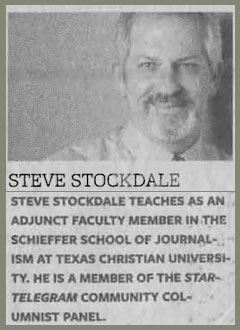
Steve Stockdale of Fort Worth is a member of the Star-Telegram community columnist panel.
© 2008 Star-Telegram and wire service sources. All Rights Reserved. http://www.star-telegram.com

Note: in the original print edition (image below), the headline was “Actually, the Constitution is pretty clear on things.” I objected to the editor afterwards and the headline on the online version was changed to the title of this post, which I thought was significantly better.

Semantic pollution fouling the airwaves

Chesapeake Energy’s impressive and expensive PR campaign has folks asking questions. Lots of questions.

One of the overlooked and under-reported aspects related to drilling in the Barnett Shale is the negative impact to our local linguistic environment.

We’re not talking particulate matter here. This is the worrisome increase in measurable propagandulate in the lower levels of what is technically referred to as the “purchased mediasphere.”

This semantic pollution poses immediate and long-term threats to the sustainability of what Stephen Colbert calls “truthiness.”

I’m talking about Chesapeake Energy’s full-frontal, body-slamming, leg-whipping, arm-twisting, head-butting propaganda blitz on behalf of the Barnett Shale.

As a 54-year-old part-time adjunct who doesn’t have anything better to do than think about these things, I’m not sure I will survive the “Summer of the Shale Sale.”

I noticed the first mildly annoying effects in the dying days of spring.

“Let’s get behind the Barnett,” intoned the serious and weathered countenance of Tommy Lee Jones. What do you mean, get “behind” the Barnett?

Then there was the release of “Citizens of the Shale,” a 30-minute “investigative news report” paid for by – Chesapeake Energy. What? An “investigative news report” paid for by a principal of the “investigation”?

In the introduction, Chesapeake CEO and Chairman Aubrey McClendon said it included “all perspectives … accurate information and fair, fact-based journalism … facts in an in-depth format … honest and balanced picture.”

I trotted out my semantic analyzing kit and measured dangerously low levels of overall truthfulness based on three samples:

  • The genial “reporter” in the piece, Ginny Simone, isn’t a reporter in the journalistic sense. She’s employed by the Mercury Group, “proven practitioners of persuasive arts and science that achieve measurable results.” (www.mercgroup.com)
  • My personal scientific analysis (I timed and counted) yielded startling results. In the 28-and-a-half-minute broadcast, someone is speaking for 26 minutes. Of 37 identified speakers, 33 speak favorably, two express specific concerns about urban drilling, two are opposed. The 33 proponents get 25 minutes, the other four get the other 60 seconds.
  • There appears a calculated effort to say, either directly or through surrogates, that natural gas is clean and doesn’t pollute, and that developing these reserves is a patriotic duty that will “make us less dependent on foreign gas.” According to the emissions tables at www.naturalgas.org and www.cleanskies.org, natural gas emits 71 percent as much carbon dioxide (CO2) as oil and 56 percent as much as coal. It actually emits 21 percent more carbon monoxide (CO) than oil, but only about one-fifth as much as coal.

So you can truthfully say natural gas is “cleaner” and “less polluting,” but you can’t honestly say that it’s “clean” and doesn’t pollute.

The U.S. certainly relies on imported oil, but we both import and export natural gas, according to the Energy Information Administration. One type of energy commodity shouldn’t be confused with another. But there’s more:

On Aug. 1, KXAS-TV aired the hourlong production, Unconventional: The Story of the Barnett Shale, in prime time, a special program “presented in partnership with Trinity Films brought to you commercial-free by Chesapeake Energy.”

A few weeks ago, Chesapeake hired Tracy Rowlett, a former TV journalist, and a slew of other former news producers and reporters.

There’s an upcoming 16-page children’s coloring/activity book featuring “Chesapeake Charlie – a friendly beagle who knows a lot about natural gas production and its many benefits.”

There are similar, some even larger, U.S. shale deposits elsewhere, which led me to Washington, D.C., home to the American Clean Skies Foundation, a nonprofit organization that hosts www.cleanskies.org, as well as an Internet broadcasting channel, www.cleanskies.tv.

This venture was announced as a “multi-million dollar media advocacy campaign to promote cleaner energy sources that includes a website, a national magazine, and a major print and television ad campaign.” The founder and funder? Aubrey McClendon.

I have no financial interest in the Barnett Shale although last December, in my previous job as executive director for a nonprofit organization, I signed a lease with Fort Worth Energy for a property owned by the organization.

I am not opposed to urban drilling. It only makes sense to exploit the natural resources we have. But it only makes sense conditionally, with proper planning, oversight and transparency throughout the entire process involving citizens, elected officials and industry.

I can understand Chesapeake wanting to get ahead of the public relations curve but this slick and ceaseless machine is over the top. And with all this Chesa-speak, why are its “competitors” – XTO, Devon, etc. – so silent?

Those are questions I can’t answer. You may have questions you can’t answer either.

Let’s ask Rowlett, the name we can trust. He starts his new gig for Chesapeake next month on www.shale.tv. He and his team of former journalists are probably going to be looking for story leads, so why don’t we send him our questions?

Steve Stockdale of Fort Worth is a member of the Star-Telegram community columnist panel.
© 2008 Star-Telegram and wire service sources. All Rights Reserved.

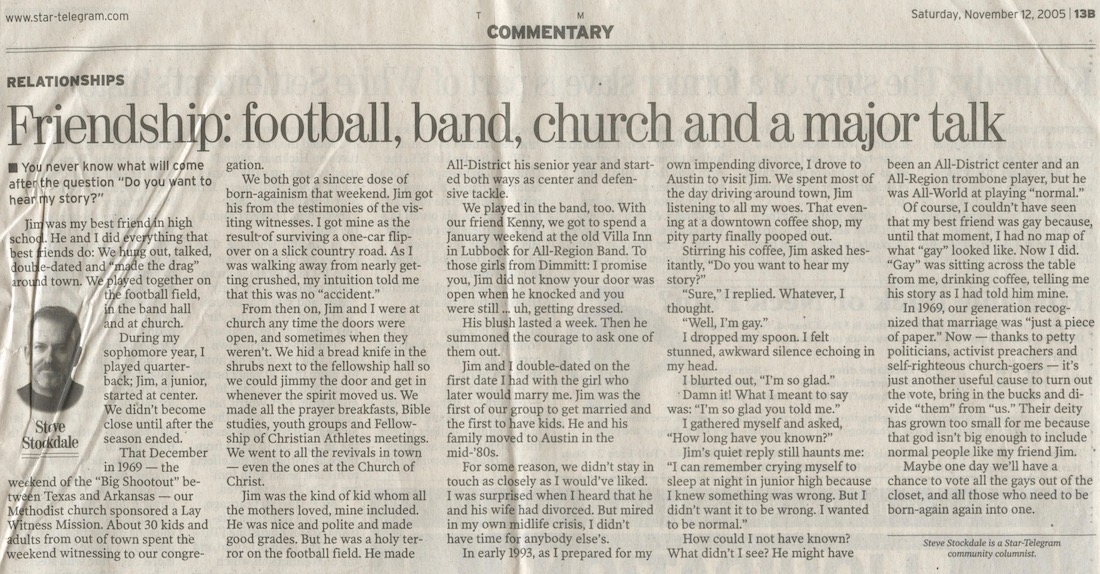
Friendship: Football, band, church and a major talk

Special to the Star-Telegram

Jim was my best friend in high school. He and I did everything that best friends do: We hung out, talked, double-dated and “made the drag” around town. We played together on the football field, in the band hall and at church.

During my sophomore year, I played quarterback; Jim, a junior, started at center. We didn’t become close until after the season ended.

That December in 1969—the weekend of the “Big Shootout” football game between Texas and Arkansas—our Methodist church sponsored a Lay Witness Mission. About 30 kids and adults from out of town spent the weekend witnessing to our congregation.

We both got a sincere dose of born-againism that weekend. Jim got his from the testimonies of the visiting witnesses. I got mine as the result of surviving a one-car flip-over on a slick country road. As I was walking away from nearly getting crushed, my sophomore intuition told me that this was no “accident.”

From then on, Jim and I were at church any time the doors were open, and sometimes when they weren’t. We hid a bread knife in the shrubs next to the fellowship hall so we could jimmy the door and get in whenever the spirit moved us. We made all the prayer breakfasts, Bible studies, youth groups and Fellowship of Christian Athletes meetings. We went to all the revivals in town—even the ones at the Church of Christ.

Jim was the kind of kid whom all the mothers loved, mine included. He was nice and polite and made good grades. But he was a holy terror on the football field. He made All-District his senior year and started both ways as center and defensive tackle.

We played in the band, too. With our friend Kenny, we got to spend a January weekend at the old Villa Inn in Lubbock for All-Region Band. To those girls from Dimmitt: I promise you, Jim did not know your door was open when he knocked and you were still … uh, getting dressed.

His blush lasted a week. Then he summoned the courage to ask one of them out.

Jim and I double-dated on the first date I had with the girl who later would marry me. Jim was the first of our group to get married and the first to have kids. He and his family moved to Austin in the mid-’80s.

For some reason, we didn’t stay in touch as closely as I would’ve liked. I was surprised when I heard that he and his wife had divorced. But mired in my own midlife crisis, I didn’t have time for anybody else’s.

In early 1993, as I prepared for my own impending divorce, I drove to Austin to visit Jim. We spent most of the day driving around town, Jim listening to all my woes. That evening at a downtown coffee shop, my pity party finally pooped out.

Stirring his coffee, Jim asked hesitantly, “Do you want to hear my story?

Sure,” I replied. Whatever, I thought.

Well, I’m gay.”

I dropped my spoon. I felt stunned, awkward silence echoing in my head.

I blurted out, “I’m so glad.”

Damn it! What I meant to say was: I’m so glad you told me.

I gathered myself and asked, “How long have you known?

Jim’s quiet reply still haunts me: “I can remember crying myself to sleep at night in junior high because I knew something was wrong. But I didn’t want it to be wrong. I wanted to be normal.”

How could I not have known? What didn’t I see? He might have been an All-District center and an All-Region trombone player, but he was All-World at playing “normal.”

Of course, I couldn’t have seen that my best friend was gay because, until that moment, I had no map of what “gay” looked like. Now I did. “Gay” was sitting across the table from me, drinking coffee, telling me his story as I had told him mine.

In 1969, our generation recognized that marriage was “just a piece of paper.” Now—thanks to petty politicians, activist preachers and self-righteous church-goers—it’s just another useful cause to turn out the vote, bring in the bucks and divide “them” from “us.”

Their deity has grown too small for me because that god isn’t big enough to include normal people like my friend Jim.

Maybe one day we’ll have a chance to vote all the gays out of the closet, and all those who need to be born-again again, in.

Steve Stockdale is a Star-Telegram community columnist.

© 2005 Star-Telegram and wire service sources. All Rights Reserved. http://www.star-telegram.com

Jim, Steve and Ken in New York City (2005)