
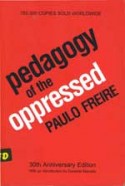
Problem-Posing vs. Problem-Solving

FreireProblem-Posing vs. Problem-Solving (Comments on Paolo Freire’s Pedagogy of the Oppressed)

When I was searching the online catalog for an afternoon course to take this term, I knew I’d found something that would resonate with me when I read the description for this course. The topic of “foundations of educational philosophy” was one that pertained directly to the reason I chose the Educational Psychology program. Then when I read the full Course Description in the syllabus, I immediately noticed the phrases “critical educational philosophy” and “reproduction of inequality.” I couldn’t wait.

I couldn’t wait because what motivates me during this period of my life is a desire to change one aspect of the educational process. But that one aspect — the teaching of language habits that are less beholden to arbitrary conventions and more consistent with what we now understand from the physical and neuro-physiological sciences — is so general that it relates and applies to virtually all subject areas. So in the process of developing my thesis, I am eager to learn about different educational philosophies and modes of thinking which have been proposed, implemented, and evaluated.

I brought a ‘critical’ (to my definition) attitude or predisposition into the course based on three primary factors. The first is based on the experiences I had during the summer of 2001 when, for three months, I thought I wanted to be a high school teacher. After a six-year career in the Air Force and twenty years as a program manager in the defense electronics industry, I knew I wanted something different. Somehow I got it into my head that I wanted to simply teach high school in a small town. However, as I learned more about what “being a teacher” in the Texas public schools meant in 2001, I knew it would be a bad fit for my temperament. My disillusions with the Texas public schools were many, but primarily included their myopic view of academic credentials as competence, insistence and reliance on standardized tests (pre-NCLB), a salary structure that encouraged teachers to leave the classroom in favor of administration, and, of course, pay graduated on seniority that, for a mid-life adult, was not acceptable.

The second critical aspect that contributed to my pre-class views is a bias in favor of science, or more specifically, a bias favoring a scientific approach or attitude. The more I’ve learned about physics, neuroscience, biology, etc., the more I’ve come to appreciate the general application of the scientific method to a broad array of problems and issues, even those that don’t have anything to do with science per se.

The third notion that has been important in my motivations is a phrase used by Jose Ortega y Gasset (mentioned in the Foreword to Pedagogy of the Oppressed). In his Mission of the University (1930), y Gasset summarizes that mission as to enable students to live “at the height of the times.” I find that a reasonably-idealistic objective to aim for, and, unfortunately, one that the current educational system fails to even acknowledge, much less attempt.

So I was eager to get into Freire’s Pedagogy of the Oppressed.

Through Chapter 2, I was generally onboard. While I was still trying to digest the implications of his clear-cut segregation of the oppressed and the oppressors, I was reassured by some familiar terms. He mentioned science, not unfavorably. He wrote about notions from humanistic psychology that I recognized — fully human (also referred to as fully functioning, full humanness, and self-actualizing by Carl Rogers, Abraham Maslow, and others); becoming, here and now. His discussion about the I and non-I were in keeping with the Taoist notion of yin and yang, which the physicist Niels Bohr called complementarity. And Freire characterized the opposites of the “banking” metaphor that are quite consistent with a scientific orientation: not static and unchanging (in other words, process-oriented, dynamic, always changing); not students as objects or receptacles (but as co-human beings); not independent and unattached (but inter-dependent and inter-related); not isolated (but inter-connected within a context or environment).

However, I grew increasingly frustrated through the remainder of the book. I realize that some of the difficulties I encountered and my initial criticisms might be more attributable to the inherent problems of translation and decisions made by the translator, not Freire. Rather than enumerate a list of what I view as inconsistencies or contradictions which might artifacts of translation, I’d like to focus on two inter-related flaws that I discern in Freire’s philosophy.

Despite his professed embrace of science, his writing (hence his thinking) does not reflect an understanding of what that means. When one engages in the practice of a scientific process, one deals from particulars to generalities, from observations to judgments, from data to results to significance. It seems apparent to me that Freire begins with his conclusions (theories, judgments, opinions, etc.) and persistently sticks to those conclusions, without bothering to actually acknowledge real data, observations, or even examples. If he were presenting Pedagogy as merely another philosophical treatise, I’d have no reason (nor interest) to criticize. But in presenting this a methodology, and couching it in science-friendly terms, I believe he’s obligated to adhere to certain minimum standards of critical discourse.

Instead, he resorts to the same rhetorical techniques commonly employed by propagandists. He presents his own evaluative constructions as though they were objective facts; in the same manner as you noted in class that race is a construct, I would argue that the oppressor, the oppressed, society, elites, the revolution and other similar abstractions are all constructs. Once constructed, Freire proceeds to reify and imbue each with all-encompassing, monolithic, unqualified, unchanging and absolute properties that must necessarily conform to his thesis. After so one-dimensionally defining and characterizing these monolithic constructs, Freire then projects his own evaluations and judgments as if they were coming from the oppressor, society, etc. With no hint of reserve or qualification, Freire attributes to them intentions, motivations, reactions, expectations, and general thinking as if he were actually inside their heads. (Save for one instance I found, on the third page of Chapter 4, where he acknowledged “it is my contention …”)

Given these gross, stereotyped constructions, Freire then turns logic on its head and decries, and eliminates by definition, what would normally be seen as dichotomies. For example, on the fourth page of Chapter 4, he explains that “no dichotomy by which this praxis could be divided into a prior stage of reflection and a subsequent stage of action. Action and reflection occur simultaneously.” How does something prior and something subsequent “occur simultaneously”? Freire eliminates the dichotomy by definition: “Critical reflection is also action.”

Therefore in Freire’s constructed world everything is related, but related as monolithic generalizations. This is perhaps the primary reason why Freire seems to advocate that there is no point in solving any one problem unless, in the course of solving that one problem, you solve all problems as he has constructed them, which ultimately results in “the revolution” that eliminates any vestige of the oppressor/oppressed construct.

Bertrand Russell noted that, “The greatest challenge to any thinker is stating the problem in a way that will allow a solution.” To my reading of Freire, this is the flaw — even if one were to accept his gross generalizations as an accurate depiction of “the current situation” (or one of the current situations) he has so convoluted the statement of the problem(s) with his obtuse and (in my estimation) confused and contradictory reliance on “the people” for solutions, there is simply no place to start. He has stated a problem so gargantuan, so historically-rooted, so globally-interrelated, that it would seem folly to even consider possible solution(s).

This is a shame because, despite my critical reaction, I can say that Freire’s ideas have affected my thinking about two current events.

Regarding the BP oil disaster, the big news from yesterday was the apology offered to BP executive Tony Hayward by Rep. Joe Barton (R-TX). Barton apologized to Hayward and BP for the, in his words, $20B “shakedown” that President Obama had forced on BP. Within four hours of the hearing, however, Barton was forced to backtrack from this apology. But it caused me to think about those individual victims who can be labeled as directly “oppressed” by the oil spill. And who would the “oppressors” be? Just BP? Hardly. Barton’s outburst could clearly be read as representative of a multi-industry, multi-governmental, multi-interested coalition with power to “oppress” everyone outside of that coalition. So what if, rather than focusing on just scapegoating BP, “we” were to take advantage of this opportunity to expose through dialogue the nature of this coalition of oppressors in a limited, semi-Freire-ian approach? I could see the benefit of ‘leveling’ the strata dividing, in this instance, not only the oppressed and the oppressors, but everyone within the context of the global environment.

Likewise, in Santa Fe there is a local controversy that could provide another test bed for a semi-Freire-ian application. On the grounds of the Santa Fe Indian School, now managed by a governing council made up of the nineteen pueblos, the architecturally-significant amphitheater designed by Paolo Solieri over fifty years ago is slated for demolition. The governing council has made it clear, according to news reports, that the amphitheater is too costly to maintain and doesn’t fit into their long-term plans. It sits on tribal land, so the council has sole decision-making authority. However, the tribal land sits within the city of Santa Fe and is serviced by local utilities. Some local officials want to leverage those utilities in an attempt to force the council to reconsider their decision. This also seems like an opportunity to apply Freire’s general approach for dialogue between two parties with different perspectives as to rights, power, culture, and self-determination, because the current dispute arises out of the past injustices. Linking the current dispute to its historical roots would widen the dialogue to address those injustices and their implications for today and the future.

That, to me, would validate at least part of Freire. While it might not end all oppression everywhere, it would go beyond merely posing a problem — it might solve one.

On Conformity

Horace MannOn Conformity: Emerson and Thoreau Respond to Mann? (Comments prompted by Horace Mann’s On the Art of Teaching)
Born within a generation, living and working within 30 miles of each other, and publishing seminal works within a six-year period, Horace Mann, Ralph Waldo Emerson, and Henry David Thoreau articulated viewpoints about a contentious American ideal that still, after 170 years, stokes and stimulates ongoing tensions. The conflict I’m referring to is that between the professed American celebration of individuality and the far more prevalent behaviors, whether dictated or chosen, associated with conformity.

I first became aware of conformity in high school. After surviving a car accident, I had a “born again” Christian experience and became active in an inter-denominational youth group in my small home town. Within months after my “re-birth” the talented members of the group performed a Christian musical, “Tell It Like It Is.” One of the more emotionally engaging numbers began with a robotic, yet melodic, refrain: Conform. Conform. I simply must conform! The scripture referenced in the song was Romans 12:2 which advised to “be not conformed to this world, but be ye transformed by the renewal of you mind.”

I took that message to heart. Even though I chose to attend the U.S. Air Force Academy to play football, I didn’t necessarily see a conflict between my individuality on one hand, and the military regimentation and authoritative conditioning to follow orders, do your duty, and conform to the program.

However, by my junior year I began considering this conflict again, prompted by reading Emerson and Thoreau in an American Literature class. Subsequently, I tried to summarize my thoughts in a one-act play titled “The Unveiling of Ourselves.” Set as a Greek morality play, my hero (“YOU”) struggles to find himself and his own identity as he is pulled by the demands of his peers (“THE GROUP”) and the temptations of an attractive seductress (“WAYS OF THE WORLD”, or “WOW”). After surviving a literal tug-of-war between the two, YOU rejects both and, through the course of the play, is determined to exercise his own will and know himself. In the end, he “unveils” himself to the audience by stripping down to a large diaper, labeled “ME”.

What did Emerson and Thoreau have to say about this subject that prompted such introspection by a college junior? The two essays that most influenced me were Emerson’s “Self-Reliance” (1841) and Thoreau’s “Walden” (1846).

I found in Emerson a persuasive advocacy for what I would call responsible individualism. His self-reliance opposed conformity. He rejected the idea of accepting any law unless that law was in accordance to his own constitution. He warned about others who seemed to think they knew better for him than he himself. Despising consistency as a near-cousin to conformity, he observed that “a foolish consistency is the hobgoblin of little minds.” He warned that others will come to expect out of you only what your past has indicated, but you are under no obligation to appease their expectations.

Thoreau likewise advocated against conformity and the status quo of public thought. But the statements from “Walden” that especially resonated with me were those that celebrated the first person “I” and that person’s abilities, if exercised, to experience life fresh and new, without respect to others’ dictates or expectations. He forthrightly proclaimed within the first few paragraphs that he would, against convention, use the first person “I” liberally, reminding the reader that, after all, it’s always the first person speaking. And he acknowledged that all he can really know is himself through his own experiences, therefore his observations would be so limited. He decried the prejudices of the old and appealed to the young to forego them based on their own actual life experiences; “old deeds for old people, new deeds for new.” He advocated that individuals embrace life in all its aspects, to take on what he called the “experiment of living.” And he recognized the consequences of not following such an individually-adopted course in his oft-quoted observation that “the mass of men lead lives of quiet desperation.”

Clearly, both Emerson (born in 1803) and Thoreau (born in 1817) were motivated by some urgent passion to advocate a new orientation for living, or world view, that seemingly was a radical departure from the then-current conventional ways of thinking. What type of public mindsets or worldviews were they reacting so strongly against?

I can only speculate, but I believe a case can be made that Horace Mann (born in 1796) can be considered a likely suspect. In 1840, after presiding over the nation’s first public, or common, school for just a year, Mann wrote On the Art of Teaching. While he did not specifically mention conformity, to my reading his words taken as a whole reflect an unmistakable disposition toward conformity as an unstated, yet not unwelcomed, consequence (if not intention) of his recommendations for teachers. Therefore I find it conceivable that Mann’s writings in 1840 could have at least partially motivated or fueled Emerson’s reactionary thoughts in 1841 and Thoreau’s in 1846.

Consider these four manifestations of conformance as I interpret Mann:

1.  Conformance to Authority (in defining what should be learned and known). Mann presumes a fixed, static and perfectly-knowable body of knowledge, as if all that needs to be learned can be bound by some previously-defined curriculum container (my term).

2.  Conformance to Process and Method. Mann exalts the efficiency and expediency of getting to the right answer in the prescribed manner, in the interests of time management. This attitude disregards the benefits to learners of pursuing and discovering alternative, creative, imaginative, or otherwise unique solutions. He reinforces the stifling and stagnating attitude that there is only one approved solution that we have used, and will always use.

3.  Conformance to Roles and Responsibilities. Mann’s approach completely compartmentalizes the role of the teacher as the dispenser of information, and that of the students as the receptacles for the information. The teacher teaches; the learners learn. Nowhere is this more evident than in his stern admonition to teachers to immediately correct any and every student mistake. Failure to correct, according to Mann, is considered equal to “wrong instruction.” If practiced, this approach denies the student the opportunity to exercise his or her own capabilities to critically discern what others say or write. It reinforces the authority and responsibility of the authority figure and dis-empowers the student.

4.  Conformance to Convention. Not surprisingly, Mann insists that teachers not allow any laxity in enforcing “proper” grammar, spelling, pronunciation, etc. While there is some benefit for individuals to comply with commonly-accepted language habits within a society, a slavish attention to the niceties of grammar, etc., — especially without any acknowledgement that every aspect of language is arbitrary at some level — further reinforces the false notion that such niceties possess an inherent “rightness.” This is but one case that illustrates how foolish conformities are justified: we must do it this way because it is (inherently) the right way.

This tension between conformity and individuality continues to play out across the American cultural landscape. While we maintain cultural icons of individuality — the rugged individual in John Wayne movies, the nostalgic romance of Jack Kerouac’s On the Road, James Dean’s Rebel Without a Cause, or even the recently-deceased Dennis Hopper’s Easy Rider — what perpetuates the icon is the fact that these characters remain the exceptions in our actual culture. For every “rebel” there are millions of [Men] in the Gray Flannel Suit; for every Kerouac there are too many Willy Loman’s (Death of a Salesman) to count. Thoreau’s “quiet desperation” is realized again and again with each new day.

One motivation for a ruling group to appeal for conformity is to avoid dealing with differences. This motivation, I believe, is one factor underlying the recently-passed anti-immigation law in Arizona. Though I’ve heard no analysis that attributes the dispute to conformity, I can speculate that much of the passion that’s driven Arizona lawmakers to enact this legislation arises not from the fact that the undocumented immigrants are illegal, but that they are different. They don’t conform to the way Arizonians talk, they don’t conform to the way Arizonians live and work, and they don’t conform to the way Arizonians dress (according to one lawmaker).

But could this prejudice, or insistence on conformity, be attributable to education? Are such attitudes taught? Are they biologically determined? Are they just absorbed? Can Mann and educators following his course be blamed, or absolved, for our current condition?

That examination must be deferred to another day and another paper. However, as a new UNM Lobo myself, I’ve observed some of the freshman orientation activities on campus this week. It might be worth reminding them that mascots are chosen for reasons. Lobos, or wolves, are one of those animals that can be considered as an icon for individuality, as in the “lone wolf.” Despite the romance of this notion, in the real world lobos and wolves are hunted, trapped, and apparently shot from helicopters because they don’t conform to the rules imposed by humans on their “domesticated” animals. Lobos don’t respect fences, don’t recognize property rights, and they don’t suppress their natural predatory tendencies. They conform to nothing other than their own natures.

Go Lobos.

Ed Psych Program Application Letter

The following is an excerpt from my application letter of intent that broadly summarizes my academic interests in the field of Educational Psychology.
My decision to pursue the M.A. in Educational Psychology is the result of a 40-year gestation period. A few significant milestones along the way:

  1. In high school I began thinking about individuality and conformity, wondering why some friends seemed to go along with the crowd while just a few acted according to their own sense of values.
  2. I wrote a one-act play at the Air Force Academy titled, “The Unveiling of Ourselves.” Patterned on the Greek morality play, the main character “YOU” struggles to discover his own sense of self while (literally) being pulled by the competing interests of “The Group” on one hand and “The Ways of the World” on the other.
  3. I read S.I. Hayakawa’s Language in Thought and Action in a graduate linguistics course at TCU in 1979. For the first time, I began to grasp the role that language plays in shaping human conflict or cooperation, tolerance or intolerance, prejudice or acceptance, conforming or marching to the beat of your own drum.
  4. In early 1993, I ‘graduated’ after three years of therapy to deal with deep unhappiness related to my marriage, work, self, etc. Feeling much better and thinking more clearly, I realized that the therapy itself consisted entirely of dialogue – I talked, the therapist listened, she talked, I listened, and then between sessions I carried on a similar dialogue inside my own head. Simply put, the therapy sessions helped me fix certain thinking habits that had become unproductive, non-sensical, and self-defeating. I realized that much of the talking therapy related directly to what I had understood from the Hayakawa book – but in the years since I had not been able to apply what I thought I understood.
  5. The following year I attended a week-long seminar conducted by the Institute of General Semantics. This ignited my ongoing passion for studying how language shapes, and is shaped by, our cognitive processes to:
    • construct individual meanings from experiences;
    • bind experiences and meanings into memory; and
    • develop, over time, an individually-unique orientation, or world view.
  6. In 2001, I resigned from the corporate career I had accepted for 19 years in order to pursue this passion. After a two years of volunteer and part-time work for the Institute of General Semantics, I served as full-time Executive Director from 2004-2007.
  7. I was asked to teach an elective course in General Semantics in the Communication Studies department at TCU in 2005. The following year I was asked to design a catalog course that would be offered in TCU’s Schieffer School of Journalism, which I taught through 2008.
  8. The scope of my academic interests is reflected in the definition of General Semantics I created for the TCU syllabus: the process of how we perceive, construct, evaluate, and respond to our life experiences.

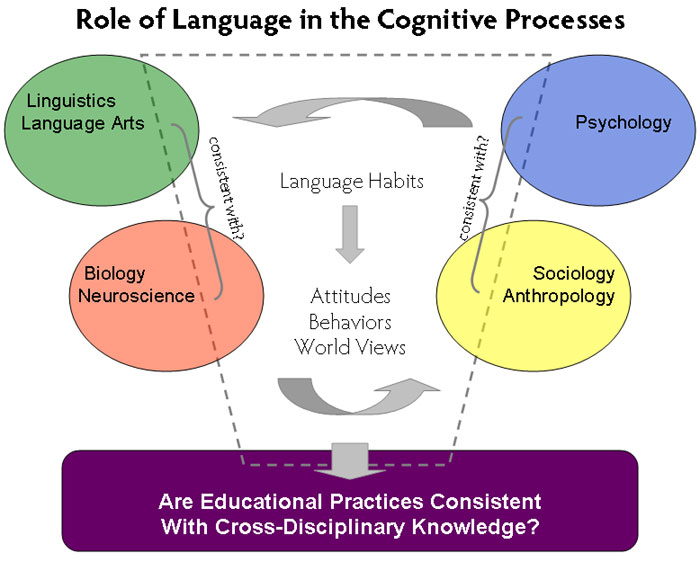
I constructed the figure below in an attempt to graphically portray the gist of my academic motivations:

Role of Language

Why have I now decided to pursue the Educational Psychology M.A. at UNM?

  1. Until I decided to take a year hiatus in 2009 and moved to Santa Fe, I didn’t think of my lack of an advanced degree as a career impediment. I knew what I knew, I knew what I wanted to write and advocate, I knew how to research the resources that satisfied my curiosities … I just needed to do it.
  2. However, over the course of the past year I reluctantly, but resolutely, realized the magnitude of two inevitable obstacles that I simply could not avoid if I expected success: a) regardless of how eloquently and persuasively I might offer my contentions, no one in the academic realm and few in the general public would accept my work if I could not report results of actual research; and b) lacking actual results, even if I were to propose a research program for others to conduct, without the credentials of an advanced degree I couldn’t reasonably expect any positive reception.
  3. Serendipitously, the UNM Educational Psychology program offers courses that I find relevant to my interests, with a specific focus on research.

If admitted to the Educational Psychology program, my intention would be to concentrate on research – theory, design, conduct, analysis, and publication. In addition to the required courses for the M.A., I would look for relevant electives in linguistics, anthropology, psychology, or perhaps biology to broaden my perspective.